- REVIEWS
Displays Electronics 
Speakers Sources Other Gear Software - HOW TO
How To Buy How To Use Tech 101

Rotel RAP-1580 Surround Amplified Processor Review Page 2
Un-Receiver-Like
I’ve been intimately familiar with Rotel’s Class A/B amps for a long time, but reacquaintance can still be disorienting. That’s because their complete dynamic confidence is so un-receiver-like, it confuses receiver-oriented expectations. The RAP-1580, like its forebears, established an iron grip on the speakers’ drivers, with the kind of solid bass you’d expect from a good outboard amp and a bracing transient snap. All amplifiers clip, but you’d have to deafen yourself to catch this one at it in my room. If your ears wilt, it’s from the quantity of sound, not the quality. As I listened, images arose out of inky blackness, not sketchily outlined but fully fleshed out, colorful, and true to life. The top end was squeaky-clean and addictively easy to listen to but not numbed or polite. The Rotel told the truth, and lots of it, and made me love it.
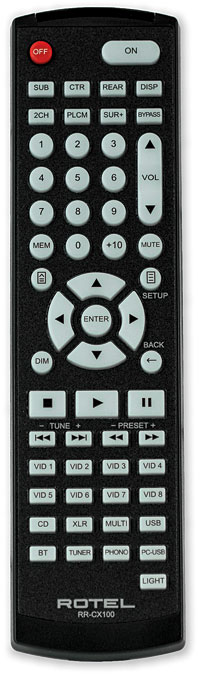 xXx: Return of Xander Cage is the kind of Dolby Atmos soundtrack I love—the kind that announces its Atmosity from the outset by punctuating the opening-title music with synthesized whooshes zipping around the top of the sonic bubble. Their height frontto-back and diagonal trajectories were a 5.1.4 perq that I wouldn’t have heard the same way in 5.1.2. This Vin Diesel vehicle pressed my surround-height buttons a few more times with effects in jungle-skiing, car-crash, and exploding-inferno scenes, along with a few more I probably missed. The Rotel handled the multichannel onslaught selfassuredly, at least with five of its amp channels called into full-on action.
Hacksaw Ridge used Atmos more sparingly but stepped up the dynamic challenge (even compared with a Vin Diesel vehicle). Height effects and dynamic peaks both occurred in the copious battlefield scenes, as the movie told the story of an Army medic who rushes into a smoking hellscape and carries 75 soldiers to safety. Although the Rotel always handled dialogue beautifully, here it surmounted an even greater challenge, as voices were layered in amongst loud explosive and ballistic effects. I was constantly surprised by how little I needed to adjust the volume (though a low-volume mode still would have been welcome).
Doctor Strange went to theaters in Atmos, and the disc was labeled Dolby Digital, but the primary Blu-ray soundtrack was actually identified by the Oppo player as DTS-HD Master Audio. It quickly won my heart by preceding a car crash with Pink Floyd’s “Interstellar Overdrive,” but the chief effects in this sorcerer’s tale accompanied onscreen spells (or “programs,” as Benedict Cumberbatch’s title character prefers to call them). This barrage of bass-heavy synthesized roars showcased the Rotel’s ability to handle dynamically demanding output just above the sub crossover.
Translucency and Sparkle
I cued up Brahms: Five Trios (Vols. I and II) by the Golub-Kaplan-Carr Trio, ripped from CD to ALAC and Bluetoothed from smartphone to receiver. While I don’t go out of my way to collect early digitalia, I fell in love with the dark-toned sound and ensemble virtuosity of this Arabesque recording immediately on hearing it reviewed on public radio back in 1989—when it still would have been considered cutting-edge. How to describe the strings? If the recording didn’t allow for perfect transparency, the Rotel did nudge it toward translucency, to stretch the metaphor. There was an indefinable gleam, a little something extra. And I was delighted with the transient crispness and sparkle of the piano. When David Shifrin’s clarinet entered in the Trio in A minor for Clarinet, Cello, and Piano, the reed instrument’s resonance was a palpably imaged thrill. Nothing meaningful got lost in the Bluetooth aptX translation.
Led Zeppelin’s Physical Graffiti (FLAC 96/24 via PC-USB) needs to be loud and epic, and once again, the Rotel delivered. Even the cheesy bits—like the druggy phase shifter that disfigures the acoustic guitar in “Bron-Yr-Aur” and the drums in “Kashmir”—sounded musically correct, if not subtle. Recorded over a long stretch at numerous homes and studios, this album has more varied guitar and drum sounds than most Led Zeppelin albums, and the Rotel excelled at revealing differences in them, large and small. The monster riffs and beefy drums lost none of their pile-driving power. They were pretty convincing even when I shut down the sub and the Paradigm speakers ran full range.

Although any phono stage would be flattered by Rotel’s amp, the internal one didn’t seem to impose any gross flaws. In Max Roach’s Freedom Now Suite, the drum sound was full but snappy (the right feel in a drummer-led band). Abbey Lincoln’s impassioned and sometimes harrowing vocals, with or without lyrics, were lifelike and convincing. The phono stage was also discerning enough to allow a hairsplitting contemplation of two versions of the Beatles’ Revolver in mono, one from the vinyl box set of The Beatles in Mono (or, as I call it, my precious) versus an early 1970s U.K. pressing. Generally, this meant smooth, sweet, and slightly soft versus harder, louder, and more unpredictable. The reissue had the advantage in lead-vocal prominence and overall organization. The original had zingier cymbals and sitar/tamboura, with the occasional surprise—such as a noticeably hazier “I’m Only Sleeping,” which was probably more appropriate, if not intrinsically better.
The Rotel RAP-1580 delivers sterling sound with especially satisfying dynamics and rich timbre. Is it worth $3,800? On the basis of sound quality, unquestionably—it could easily go head to head with a good pre/pro and any one-chassis multichannel amp. If you want to power demanding speakers with a one-box solution, this is your best shot.
However, despite the boon of the PC-USB input, great sound comes at the cost of a trimmed-down feature set. Even when the dodgy software receives its promised corrections, this seven-channel model will never deliver more than 5.1.2-channel surround without a band-aid, and that limits you to just one pair of conventional (passive) height speakers in Dolby Atmos and DTS:X. Still, accounting for its limitations, those who want both the power and the subtlety of separates will find this the ultimate music and movie machine.





































| Displays Electronics Speakers | |
Sources Other Gear Software | |
Top Picks of the Year Top Picks | |
Custom Install How To Buy How To Use | |
Tech 101
|
|
Latest News Features Blogs | |
Resources Subscriptions |
WHERE TECHNOLOGY BECOMES ENTERTAINMENT
 © 2026 Sound&Vision
AVTech Media Americas Inc., USA
All rights reserved