- REVIEWS
Displays Electronics 
Speakers Sources Other Gear Software - HOW TO
How To Buy How To Use Tech 101

Cambridge Audio CXR120 A/V Receiver Review Page 2
Gimme Some Truth
What should an audiophile receiver sound like? Should it be rigorously neutral, or should it dole out a little extra gravy in the form of midrange warmth? Previous Cambridge receivers tended toward neutrality, with highs that were refreshingly detailed but proportionate. The Duchess was no exception. The top end was open and uncolored. The receiver could muster decent bass, too, though this became a double-edged sword due to the lack of room correction.
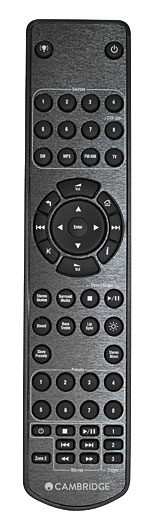 As Taken 3 got underway, I quickly noticed that the receiver required three-quarters of its volume scale to muster audible dialogue and action-movie-worthy effects in my relatively modest listening space and with my speakers of average efficiency. However, the way a volume control’s range is calibrated is not an indicator of its actual power output capabilities; as usual, see what our measurements say. The Duchess was graceful and well behaved at volume peaks, smoothly integrating effects and remaining listenable under duress. Bass was as full and clean as a good amp should make it but lacked the sculpting I’ve gotten used to with well-executed room correction. I found that everything from the movie’s copious explosions to Liam Neeson’s tense, gravel-voiced fury—the nemesis of kidnappers everywhere—tended to detach and localize in the subwoofer. I compensated with a minor adjustment to the sub’s volume control, preferring less bass overall to congested bass at certain frequencies.
The bass adjustments continued with Blackhat, a Chris Hemsworth hacker-thriller with an unusually bassy soundtrack. The opening scene punctuates a nuclear meltdown with throaty synth effects that bounded out of the speakers and especially the sub, prompting another lunge to the sub’s volume control. But that was only one-tenth of the story. The other 90 percent was just how pleasurable even the most aggressive movie soundtracks could become via this timbrally reliable, dynamically assured receiver—even when it operated with the volume at 75 to 80 percent of the scale.
The alternatingly terrifying and wonderful historical events depicted in Selma showed how natural voices could sound with the receiver. The resonant tenor of leading man David Oyelowo, as Martin Luther King, Jr., fortunately didn’t localize in the sub but did blend well into the acoustics of public speaking venues. The orchestral score leading to the second encounter on the bridge was warm and heart-tugging. More voices—notably John Legend and Common singing “Glory” and the massed voices singing “This Little Light of Mine” in a Folkways historical recording—allowed the receiver to deliver the goods musically, as it invariably did in the music demos themselves.
From Naples with Love
An SACD of Baroque chamber works by the Neapolitan composer Francesco Provenzale was unexpectedly arresting. This collection, Amati Orrori: Lamenti & Cantatas, is performed by the ensemble Echo du Danube, and the multichannel version—in 5.0, with active center but no LFE—gave the receiver chances to shine at both the top and bottom ends. Prominent at the top was the salterio, a dulcimer-like instrument that can be hammered or plucked (in this case, hammered). The spidery runs of glittering tone color were startling and offered a counterpoint to the bright sunbeams of period violin and viola da gamba. When the percussion entered with a drum unspecified in the credits, the un-room-corrected bass was predictably full, but the firm control of its decay was also thrilling. The Duchess of Cambridge wouldn’t let me read a book while playing this music (which was my original intention). I had to put down the book and listen, spellbound. One quibble: The receiver is supposed to recognize DSD via HDMI but did not. I’m told a future software update will fix the problem.
One of my seven vinyl copies of The Beatles (yes, “The White Album,” and yes, I am obsessed) is a 1976 Japanese pressing that I prize for shining a light into the murky mixes of some songs. The tradeoff is that the shrieking jet noise of “Back in the U.S.S.R.” can be a tough way to get started. No, the Cambridge wouldn’t soft-pedal the aggressive effect—but once I got beyond it, the receiver’s clear-as-glass midrange delivered crystalline perfection with hypnotic songs like John Lennon’s “Dear Prudence” and “Julia” and George Harrison’s hushed “Long, Long, Long.” While it’s hard to find a pressing (or a receiver) that doesn’t flatter the beautifully balanced string and horn charts of Paul McCartney’s “Martha My Dear,” the Cambridge gave them extrawell-defined shape and texture. The magic vinyl and receiver delivered all four of the band’s voices (five, if you count Yoko’s) with every morsel of their glorious timbre.
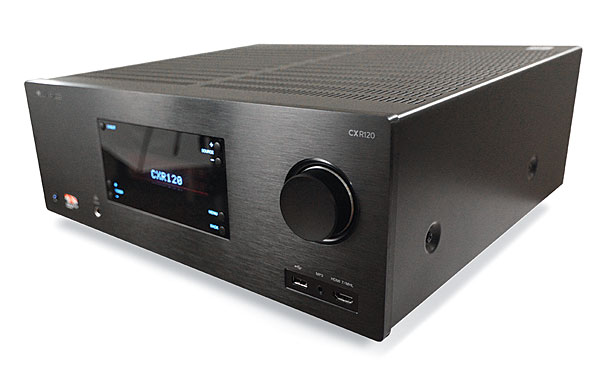
The untitled CD of trumpeter Clifford Brown and drummer Max Roach is in 1954-vintage mono and therefore a good test for center imaging when played in stereo mode. The Duchess aced it, vividly defining the trumpet and Harold Land’s tenor sax without the crutch of room correction, with the piano, bass, and drums recessed behind them. She added something to this schematic but decent recording that’s hard to define. It wasn’t sweetness or warmth—just a high level of resolution that was easy on the ears. This familiar CD never sounded better.
Installing the Cambridge Connect app onto an iPad mini, I was able to access music from a network-connected PC as well as the iPad itself. The app is simple, quietly elegant, and easy to learn, though in some respects, it’s not as slick as a receiver with integrated AirPlay. The app adjusted volume only with its own control, not the tablet’s volume keys. And it wouldn’t operate in the background when I used a browser. So I finally spent some time with that book I’d put down a few evenings before, while Bill Evans’ Live at the Village Vanguard (ripped in Apple Lossless) played in the background.
Cambridge Audio’s CXR120 is an audiophile receiver par excellence, with all the nuance and finesse a music lover might crave. It’s not the right receiver for someone who wants Atmos, room correction, or integrated Bluetooth or AirPlay, all of which are available at much lower prices. But it’s a great choice if you’re into vinyl, high-resolution audio, and the streaming of hi-res formats. The Duchess of Cambridge is a great lady indeed.
| |||||||||||

| |
| |||||||||











































| Displays Electronics Speakers | |
Sources Other Gear Software | |
Top Picks of the Year Top Picks | |
Custom Install How To Buy How To Use | |
Tech 101
|
|
Latest News Features Blogs | |
Resources Subscriptions |
WHERE TECHNOLOGY BECOMES ENTERTAINMENT
 © 2026 Sound&Vision
AVTech Media Americas Inc., USA
All rights reserved