- REVIEWS
Displays Electronics 
Speakers Sources Other Gear Software - HOW TO
How To Buy How To Use Tech 101

BenQ HT1070 DLP Projector Review Test Bench
Full-On/Full-Off Contrast Ratio: 1,706:1
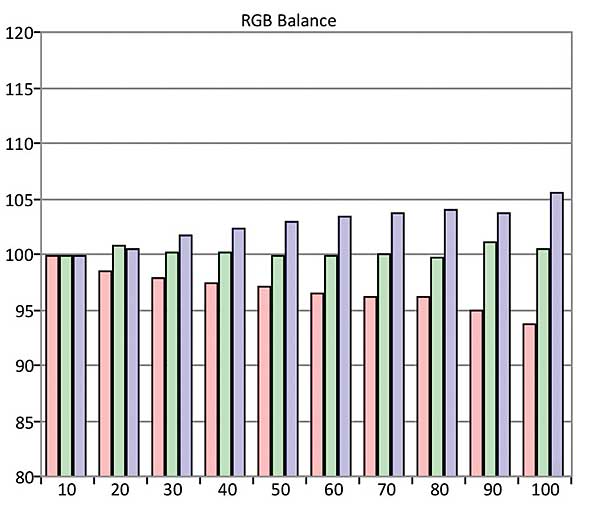
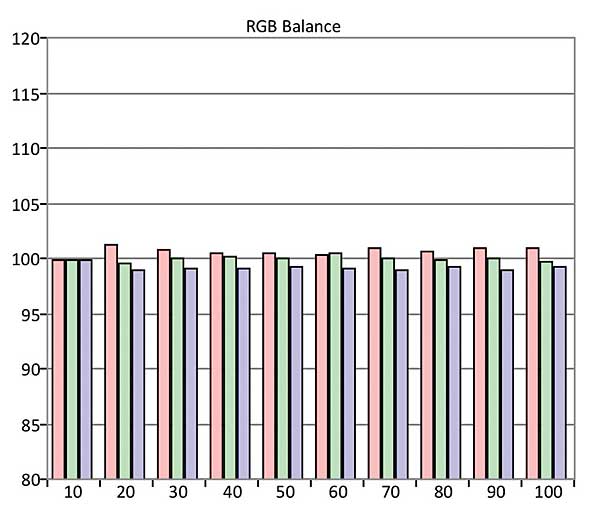
Pre- and post-calibration measurements were made in the BenQ HT1070’s Cinema preset. Maximum contrast measurements were made in Cinema mode with the Economic lamp setting active. With this configuration, the BenQ’s black level measured 0.015 ft-L and peak white 25.6 ft-L, for a contrast ratio of 1,706:1.
Highest peak brightness was delivered by the default settings in the Bright preset: 72.4 ft-L. The projector’s Sports and Vivid presets both yielded around 50 ft-L. Fan noise in this and other presets with lamp mode set to Normal was noticeable at my seat 4 feet behind the projector.
Before calibration, the BenQ’s Normal color temperature preset in Cinema mode delivered a mostly accurate but slightly bluish grayscale, with the Delta E averaging out to a respectable 2.2. Calibration improved that to 1.0, with a high of 3.3 at 10% brightness. (Delta E is a figure of merit that indicates how closely a display adheres to the Rec. 709 HD color standard. Experts generally agree that levels below 3 are visibly indistinguishable from perfect color tracking.)
With the Cinema mode’s default settings active, the BenQ’s measured color points were mostly off target, with the Delta E averaging out to 5.7. Calibration using the projector’s color management system, which provided limited range for making adjustments, improved that number slightly to 3.8.
With the 2.2 Gamma preset selected, gamma in the Cinema mode averaged 2.2 and displayed mostly smooth tracking up until the 80-IRE point. Post-calibration, gamma was more linear, closely tracking 2.2 for the full measured brightness range.
Picture uniformity was excellent, with gray full-field test patterns showing no visible tinting. The BenQ performed unevenly on our suite of video processing tests. Clipping, luma, and chroma resolution all checked out fine, but the HT1070 received a failing grade with HD and SD 2:2 pulldown patterns. That’s a somewhat common failure and one that won’t frequently come into play with day-to-day program material.—AG































| Displays Electronics Speakers | |
Sources Other Gear Software | |
Top Picks of the Year Top Picks | |
Custom Install How To Buy How To Use | |
Tech 101
|
|
Latest News Features Blogs | |
Resources Subscriptions |
WHERE TECHNOLOGY BECOMES ENTERTAINMENT
 © 2026 Sound&Vision
AVTech Media Americas Inc., USA
All rights reserved