Let me make one thing perfectly clear. This is not your father's stereo. In fact, it's not his home theater either. Kenwood has come up with a networked home entertainment system that promises to provide easy access to movies from a DVD megachanger and music from a variety of sources, including CDs, MP3 music files stored on a hard-disk drive - even Internet radio stations.
Running with a stack of my favorite CDs compressed into a player no larger than a deck of cards, I set a personal best on the trail around the Central Park Reservoir.
You wouldn't know it to look at the "mine's bigger than yours" installations featured in some home theater magazines, but having a decent amount of money to spend on a whole-house audio/video system doesn't necessarily translate into gaudy opulence. Or, to put it another way, modesty isn't always dictated by a limited budget.
For a century we've been industriously broadcasting radio programs all across the globe, with the great majority of programs received free of charge. After light bulbs, radios are probably the most ubiquitous electrical devices on earth. Radio is cool. Life is good.
He may not have known all the chords . . . but he knew "a lot more than we knew," as John Lennon said, remembering the day in 1957 when Paul McCartney introduced him to George Harrison. And that was enough for John to agree with Paul that George should join them in the band that would eventually become, with Ringo Starr, the Beatles.
Ever since that Philips commercial where a European-looking couple try hanging their thin TV in every room of a minimalist apartment, finally settling for a spot on the ceiling above the bed, plasma sets have been creating a stir. From airports to movie theaters to corporate boardrooms, these slimmed-down big-screen TVs draw stares from almost everybody.
KENWOOD/BOSTON UNITYDimensions (WxHxD) main unit, 18 x 33/4 x 161/8 inches; subwoofer, 14 x 13 7/8 x 13 3/4 inches System weight 45 1/2 pounds Price $1,000
If the major record labels have their way, that bright red "record" indicator on your CD burner or personal computer could eventually become as unresponsive as the long-wave band on a vintage AM radio. Some of the labels have already released music discs that prevent you from using your computer to make digital copies on either recordable CDs or the computer's hard drive.
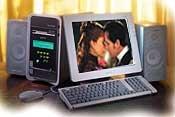
At $2,800, the least expensive Vaio PC in Sony's MX desktop line doesn't seem like much of a bargain these days, even for a 1.7-GHz, Pentium 4 with an 80-gigabyte (GB) hard drive, 512 megabytes (MB) of memory, the exciting "home" version of Windows XP, and two better-than-average speakers (the 15-inch Sony LCD monitor shown is $600 extra).
Okay, I know I shouldn't gloat. But I told you so. In a keynote speech at the National Association of Broadcasters (NAB) annual convention a year ago, I warned that if the broadcast and cable industries didn't get their act together when it came to putting high-definition signals out there in a big way, high-def programming would be provided by other means.
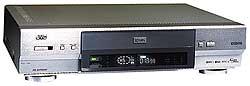
Four of Hollywood's home-video heavies - DreamWorks, 20th Century Fox, Artisan Entertainment, and Universal Studios - have thrown their weight behind a format for distributing films in high-definition, the JVC-developed D-Theater variant of D-VHS.
Because every new format seems to set off a format war, we were a little surprised when nine major electronics manufacturers announced that they actually agreed on what the next-generation recordable optical-disc format should be.
There's no denying that digital high-definition TV (HDTV) is a vast improvement over our old analog TV system, but if you want to record any of the high-def programs delivered over the air by local broadcasters or via satellite from Dish Network or DirecTV, your options are ridiculously limited.
Wild Blue Yonder Okay, I know I shouldn't gloat. But I told you so. The breathtaking, commercial-free imagery of a packaged HDTV medium would persuade people to watch less broadcast and cable TV. That new medium has arrived.
Since he first delighted audiences and divided critics with his stylized, idiosyncratic first feature, Strictly Ballroom, writer/ director Baz Luhrmann has gone on to make Romeo+Juliet and Moulin Rouge - each more ambitious, more stylized, and more dividing of critics than the last. Each has also had greater success at the box office and in accumulating awards both in the U.S.