OTHER TECH

Sort By: Post DateTitle Publish Date
Thomas J. Norton  |  Jul 14, 2009
THX, Dolby, and Audyssey deliver reference-level punch at lower volumes.

You know the drill. You’re just getting into the latest action blockbuster on your new home theater rig when a still, small voice wafts gently into your SPL-addled ear. “Isn’t that a bit loud?” Or perhaps the voice comes screeching in from another room. “I can’t hear myself think in here.” Or there’s a knock at the front door from the men in blue, demanding that you surrender your assault rifle in exchange for a fun stay in the slam with Tony the Hammer.

John Higgins  |  Dec 30, 2006  |  First Published: Dec 03, 2006
Making your computer feel Blu(-ray).

The big news in 2006 has been the emergence of two new high-def DVD formats—Blu-ray and HD DVD. With greater storage capacity than a traditional DVD, we can now get higher-quality audio and video on the small screen. Depending on the compression used, each release can contain a whole slew of extras—or you can fit entire seasons of television shows, in SD, on one disc. Now, with the introduction of some internal drives for the home computer, you can back up vast amounts of information with a single disc. My personal iTunes music library, which contains the majority of my CDs, encoded as AAC files at 192 kilobits per second (stereo), could almost all fit on one Blu-ray disc. That's three-and-a-half months of continuous music. Add the ability to play Blu-ray titles, and it's the perfect time to move that home computer into the home theater for some high-def goodness. Before you get too excited and run out to buy a new drive, there are a few things that you need to consider first.

Gary Merson  |  May 25, 2006
What's the difference?

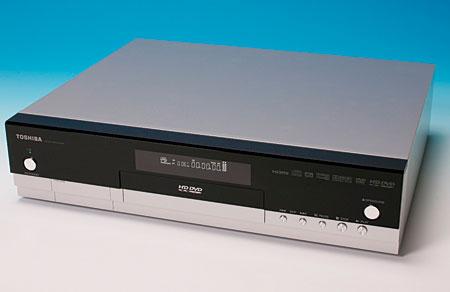
The next generation of prerecorded video content is here. The new machines use a blue-violet laser to read discs with far more storage capacity than current standard-definition DVD, and they can play high-definition content in full 1,920-by-1,080 resolution. The big attraction is the promise of the best picture quality you have ever seen on a display. The prerecorded, high-definition content offers pristine, near-perfect images with fewer artifacts (noise and blocking) than is possible today with broadcast or D-VHS content.

John Higgins  |  Jan 13, 2006
Computers are everywhere, from our desktops to our phones to our planes, trains, and automobiles. If we look at movies like I, Robot (strictly from a conceptual standpoint, not a why-did-Hollywood-ever-make-this standpoint), there is a possible bleak future ahead of us. I prefer to look at Star Wars, where machines help, even if they can be annoying know-it-alls. Granted it's not our galaxy, but it is a lot more fun to watch than I, Robot (no disrespect to the Fresh Prince). What better way is there to improve your home theater experience than the addition of a PC? But what should you look for when setting out to buy one?
Rachel Weintraub  |  Dec 06, 2005  |  First Published: Dec 07, 2005
Getting your videocassettes with the times.

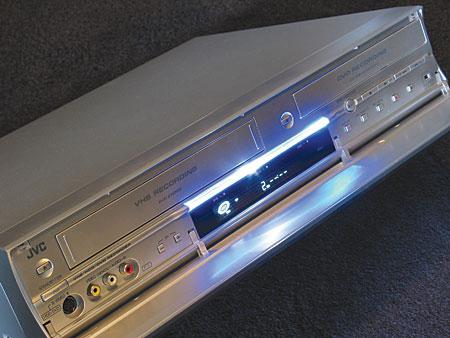
I admit it: I'm a recording junkie. For years, I recorded my favorite TV shows on VHS videotape, only to watch them gather dust in the garage. Now that I have a DVR and a DVD recorder, what use have I for those clanky, cranky cassettes? Actually, more than you might think; some of those cassettes have irreplaceable moments from my TV-watching past, moments I'd rather not lose as the tape disintegrates with age.

Adrienne Maxwell  |  Oct 29, 2005
Storage and tuners and menus, oh my!

You've heard that a digital video recorder (DVR) will change the way you watch TV, and you know you want one. Beyond that, you're at a loss. How do you choose between the different models? How do you even know what to look for? Here are some questions to help guide you on your way to time-shifting bliss.

Scott Wilkinson  |  Jun 26, 2005
When home theater enthusiasts talk about their audio systems, they usually concentrate on components such as the disc player, receiver (or preamp-processor and power amps), and speakers. But there's another component that deserves just as much attention: the cables that connect the other devices together. Without cables, those other components would be nothing more than expensive boat anchors.
Michael Fremer  |  May 08, 2005
In our ongoing run-up to our 10th anniversary in early 2005, Michael Fremer looks at his experiences working on the soundtrack to the groundbreaking movie Tron. This article was first published in our Fall 1997 issue. We've made a few edits to account for changes since then (particularly in the references to laserdiscs!), but MF's description of the creation of an early-1980s soundtrack is as fascinating, interesting, and pertinent as ever. Modern digital techniques have revolutionized the film-sound business, but a good soundtrack is still a good soundtrack.
Chris Chiarella  |  Sep 02, 2002  |  First Published: Sep 03, 2002
A bigger hard drive, a little time, and you're halfway there. I'm a lucky guy. My wife and I have had only one major squabble since the beginning of the year, and it was about sharing the space on our personal video recorder's rapidly filling hard drive. My problem: I've fallen behind in archiving and deleting my keeper episodes. Hers: She waits too long to watch her recorded Ally McBeal, Buffy, and Friends, and the PVR automatically purges them. Although many possible solutions exist (Ally was cancelled, thankfully), the simplest would be to add a larger hard drive. Compared with the purchase of a newer, higher-capacity PVR, this approach is quite economical, and it's a project that a home theater buff with some electronics/computer expertise can tackle.
Chris Lewis  |  Jul 02, 2001  |  First Published: Jul 03, 2001
Part two in our high-resolution-audio series introduces SACD and DSD. The CD is dead. Long live the super CD.

You must allow me a bit of hyperbole for the sake of a powerful opening statement (which, as I assume they say in journalism school, is important). The truth is, the CD is about as dead as the analog television, which means it's alive and kicking just as it has always been. Still, the writing is on the wall for both formats. While the CD can at least take consolation in the fact that it doesn't have government mandates guaranteeing its demise, the future of audio has most definitely arrived (as with television) in the form of high-resolution. Let's not forget multichannel, either. While the hard-core music lovers are salivating over the potential of high-resolution, most are well aware that popular acceptance in America usually requires the new and different to be as big and flashy as possible. On many systems, the multichannel format is undoubtedly going to represent a more-noticeable change in the way people listen to music.

Mike Wood  |  Jul 02, 2001  |  First Published: Jul 03, 2001
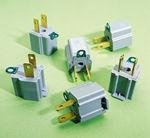
Feeding the Beast and Chasing Its Gremlins : A basic guide for harnessing AC power.

There's absolutely nothing worse than putting together an awesome home theater system that's starved for power or buzzing with ground loops. We often take electricity for granted, assuming it will be there when we need it. Unfortunately, that's not always the case. You don't necessarily need an electrician just to connect your audio and video system, but you may need to check out your electrical system before you spend hours, if not days, connecting all your components. The two things you should consider are whether your system is getting enough power and if your components are connected to that power system correctly.

Mike Wood  |  May 02, 2001  |  First Published: May 03, 2001
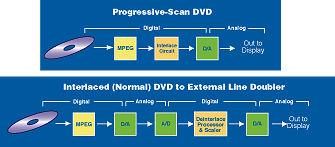
The truth behind progressive-scan DVD players.

Conspiracy theories are like computer problems—almost everyone has one. From JFK's assassination to the demise of TWA flight 800, it's rare that everyone will accept the simplest explanation as the truth. Consumer electronics has its fair share of conspiracy theories, as well. They may not be as complex as a Louisiana district attorney's triangulated-bullet-trajectory theory, but they exist, nonetheless. What do you expect to happen when a large number of obsessive-compulsive personalities have too much free time and join a chat room?

Mike Wood  |  Feb 28, 2001  |  First Published: Mar 01, 2001
The world's most complete guide to DVD-player features.

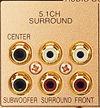
If you're thinking of buying a DVD player, the number of features most players offer might overwhelm you. Sure, you know the basics: DVD is the hottest thing since the first time man invented something round. It consists of a disc the size of an audio CD but with 10 to 15 times more storage capacity. The disc has enough room to store a full-length motion picture with a digital picture that's better than that of laserdisc or satellite broadcasts. A progressive-scan DVD player connected to a widescreen TV can even approach the quality of high-definition television. The digital audio can include up to five full-range, discrete (meaning separate) channels with one LFE, or low-frequency-effects (aka the .1), channel for impact. The best part is that DVD players and movies should be compatible with your current system, no matter how archaic it is. You can buy a DVD player now and almost certainly enjoy the benefits right away, and you can upgrade various parts of your system and glean even more performance from the DVD software that you'll undoubtedly start collecting. What you really want to know, though, is what features to look for in your first/next DVD-player purchase. As usual, we're here to explain them to you. We've also included a couple of tips on how you can take your DVD/home theater experience to the next level.

Mike McGann  |  Feb 28, 2000  |  First Published: Feb 29, 2000

Editor makes stupid grounding mistakes and pays with fried gear.

Those of you who have installed your own satellite systems have seen RG-6 coaxial cable with a second wire attached to the outside. I can't speak for the rest of you, but I know I never paid a whole lot of attention to that second wire. Sure, it was handy for tying the cable to stuff and so on, but, frankly, who really gives it a whole lot of thought? Even our detail-oriented (PC for anal retentive) technical editor Mike Wood admits he's never found much need for it, either. That is, until he heard my tale of woe.

David Ranada  |  Jan 31, 1999
I felt as stupid as Dorothy must have felt near the end of The Wizard of Oz when Glinda, the Witch of the North, tells her that she always had the power to get back to Kansas.

Pages

X