- REVIEWS
Displays Electronics 
Speakers Sources Other Gear Software - HOW TO
How To Buy How To Use Tech 101
3D Music Albums
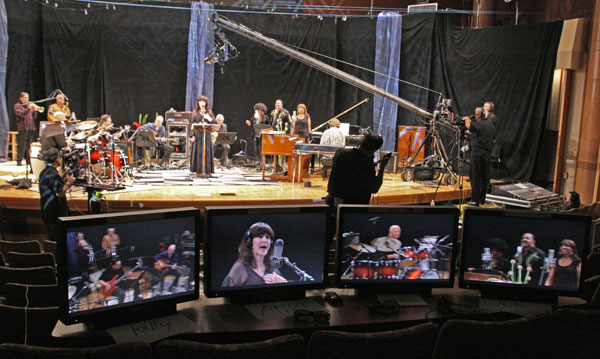
All photos by Scott Wilkinson
AIX Records is well known among audiophiles as an excellent source of high-resolution surround and 2-channel music on DVD-Audio/Video and Blu-ray. In addition to audio, these titles also include video of the sessions, with high def on newer releases. Now, AIX has taken a giant step into the future, becoming the first label to shoot 3D video for a series of "3D music albums" to be released on Blu-ray later this year.
AIX owner, engineer, and producer Mark Waldrepwho has been a guest on my podcastcaptures complete performances in acoustically rich spaces, relying entirely on the artists' superb musicianship. The result is a "private performance" by the artist for those with a home-theater system.
The 3D sessions were recorded over three days at the Colburn School's Zipper Hall in Los Angeles, California. I've performed in that hall, and it's among the finest in the area, so when Waldrep invited me to attend, I jumped at the chance.
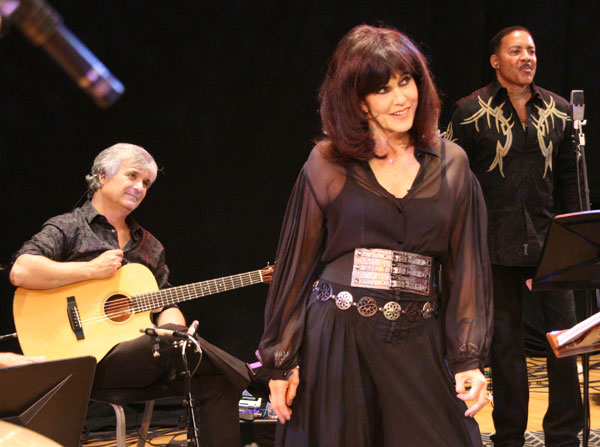
L-R: Laurence Juber (acoustic guitar), Rita Coolidge, Oren Waters (backing vocals)
The day I was there, Rita Coolidge was recording an album of Memphis-style R&B. Other artists on these sessions included multi-platinum country star Mark Chesnutt, jazz/classical group Free Flight with James Walker, guitarist Laurence Juber, The Old Towne String Quartet, and the AIX All Stars with various top-notch artists combining their talents.
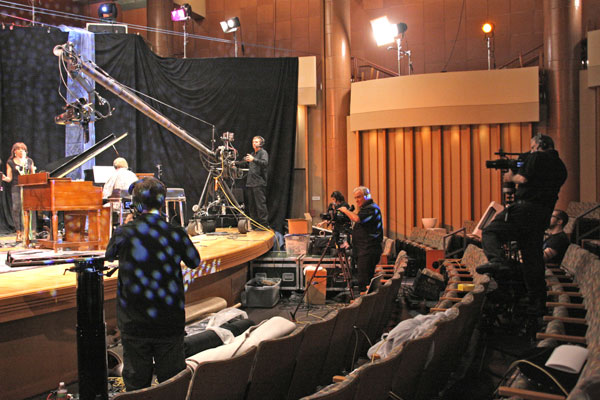
Four Panasonic 3D cameras caught the performance from many angles.
Waldrep managed to finagle four prototype 3D cameras from Panasonic for the three-day shoot, along with four prototype 3D LCD monitors that employ passive-polarized glasses. The cameras use AVCHD compression and store the data on 32GB SD memory cards, one for each eye. (Data wrangler Brent Curtis, whose regular job is authoring AIX DVDs and Blu-rays, had his hands full keeping track of all those memory cards and backups!) Each camera sent the left and right images to its corresponding monitor via separate HD SDI cables.
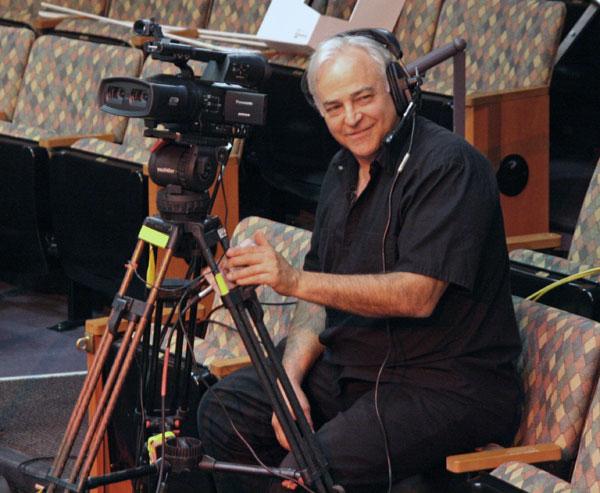
DP Greg Le Duc
Director of photography Greg Le Duc decided to shoot at 1080p/30 rather than 1080p/24 in order to capture smoother motion, especially from the drummer and the guitarists' fingers. The video will be interlaced to 1080i on the discs, since Blu-ray doesn't support 1080p/30, and of course, it will conform to the Blu-ray 3D spec.
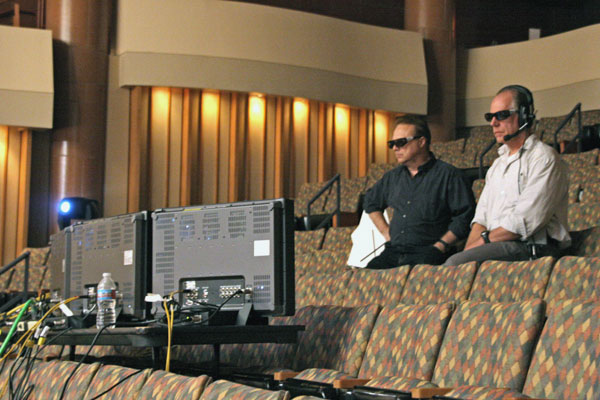
Stereographer Dave Gregory (L) and producer Mark Waldrep watched the 3D monitors with passive-polarized glasses.
All four cameramen and stereographer Dave Gregory agreed that the Panasonic cameras were a real boon, requiring very little learning curve and taking no more time to shoot than 2D would. Not only that, they are far less expensive than 2-camera beam-splitter rigs would have been$21,000 each, which is peanuts in the world of professional video.
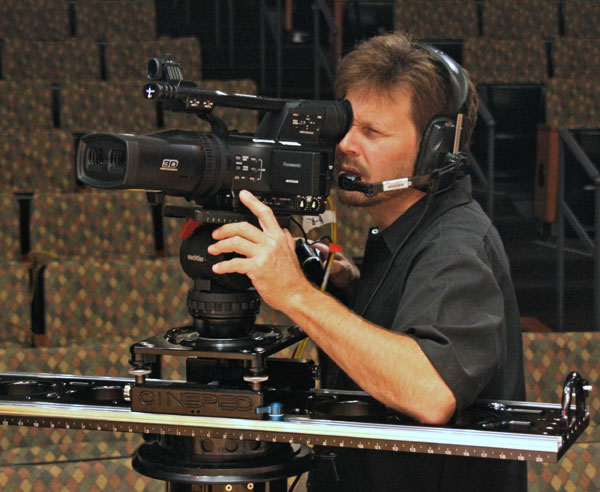
Cameraman Andy Parke
Of course, shooting in 3D requires some care in order to avoid problems unique to stereoscopic images. For example, the convergencewhich determines where the screen plane is along the depth axiswas normally set and left alone, but it needed to be adjusted for long and extreme zoom shots. Also, they kept the cameras at least 10 feet from the subjects in most cases to avoid parallax problems.
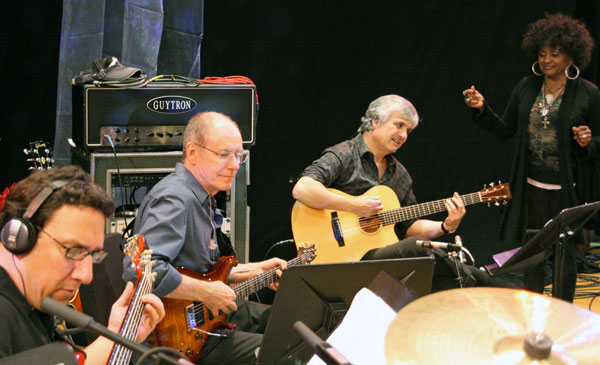
L-R: Kevin Axt (bass), Dean Parka (electric guitar), Laurence Juber (acoustic guitar), Julia Waters (backing vocals)
Regarding the audio, Waldrep always records uncompressed PCM digital audio at 96kHz/24 bits, which he refers to as "high definition" rather than "high resolution." After all, he says, many audiophiles consider vinyl records and analog tape to be "high resolution" in a sense, and he wants to differentiate digital recordings that are originally made using higher sample rates and longer word lengths than CDs offer.
For these sessions, he recorded 36 tracks on a PC-based Nuendo digital-audio workstation, using lots of dual-microphone pairs on the guitars and percussion. He prefers to capture the acoustic sound of each instrument, even electric-guitar cabinets, which creates an open, live sound and allows the musicians to better hear each other.
Like other AIX titles, several mixes of each tune will be provided on the discs, including 5.1 mixes from the audience and stage perspectives as well as a 2-channel version. Why not 7.1? Because 5.1 matches the label's other surround mixes, and many home systems don't have the extra back-surround speakers.
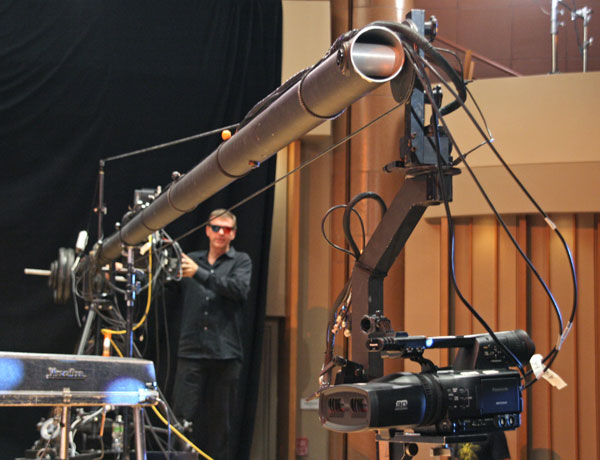
Jib cameraman Kelly Herrin
A few 3D music movies have already been produced by artists such as U2, Hannah Montana, and Kenny Chesney, but these are all live concerts with full audiences. AIX will be the first label to offer 3D music albums that provide a more intimate private performance, and I can't wait to seeand hearthe final result.





























| Displays Electronics Speakers | |
Sources Other Gear Software | |
Top Picks of the Year Top Picks | |
Custom Install How To Buy How To Use | |
Tech 101
|
|
Latest News Features Blogs | |
Resources Subscriptions |
WHERE TECHNOLOGY BECOMES ENTERTAINMENT
 © 2026 Sound&Vision
AVTech Media Americas Inc., USA
All rights reserved