- REVIEWS
Displays Electronics 
Speakers Sources Other Gear Software - HOW TO
How To Buy How To Use Tech 101
Polk Audio LC265i-IP In-Wall IP Speaker System
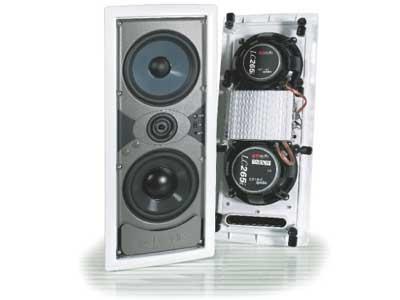
You can't rush a good thing, and some things just aren't ready until they're ready. With electronics, coming to market too early usually means a product that's lacking in features, full of bugs, and short on performance.
| What We Think |
| You get freestanding-speaker sound with an in-wall footprint from Polk's forward-looking IP speakers, but it's gonna cost you. |
SETUP I've never before installed a pair of speakers and thought, "Man, I hope this works." But the LC265i-IPs are no ordinary speakers, and installing them is more like adding a device to your home network.
In-wall speakers should be auditioned in walls, and Polk obliged by sending pre-built wall sections made from framing and sheetrock. For the best sound - that is, tighter low- and mid-bass - and to eliminate rattles, Polk installed its Performance Enclosures (55.6 x 14 x 3.4 inches, $250 each). Unless you plan on some massive drywall repair, these enclosures should be installed during new construction.
The Polks are self-amplified and can function in a traditional audio system. They have RCA line-level inputs that accept the stereo output from your receiver's pre-outs or mulitzone output. Both left and right signals go to one speaker designated as the "control" by flipping three dip switches on the speaker's back. Cat-5 cabling links the two speakers together.
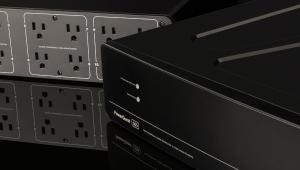
Since both speakers are triamplified (200 watts total: 100 watts to the woofer, 75 watts to the midrange driver, and 25 watts to the tweeter), they also need power, which is carried over a 4-conductor wire running back to a Polk Audio SPS-1 power supply ($700).
| |||||||||
|

| ||||||||














































| Displays Electronics Speakers | |
Sources Other Gear Software | |
Top Picks of the Year Top Picks | |
Custom Install How To Buy How To Use | |
Tech 101
|
|
Latest News Features Blogs | |
Resources Subscriptions |
WHERE TECHNOLOGY BECOMES ENTERTAINMENT
 © 2026 Sound&Vision
AVTech Media Americas Inc., USA
All rights reserved