Projector Reviews

Sort By: Post DateTitle Publish Date
David Vaughn  |  Jan 21, 2008

It is a great time to be a home theater enthusiast. Sure, the format war between rivals HD DVD and Blu-ray Disc has been distracting. But the price of 1080p projectors has fallen from the stratosphere to price levels many can actually afford. Prices of 1080p projectors are now below the $3,000 mark, and we're not talking stripped down bargain units or last year's closeouts either.

Thomas J. Norton  |  Mar 20, 2005

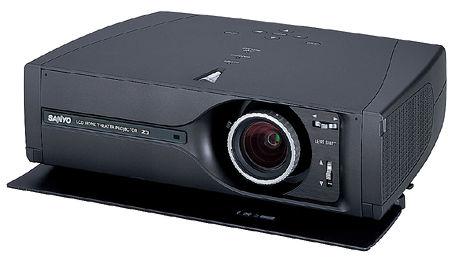
With its fold-down front panel and uninspiring plastic case, the Sanyo PLV-Z3 suggests nothing so much as a large (okay, very large) clock radio. In a world where, not so very long ago, video projectors were expected to require three or four strong longshoremen to deliver and set up, the newest digital designs still generate a sense of wonder. Even now, audiophiles continue to equate size and mass with quality, and "longer, lower, wider" are still the watchwords with car enthusiasts (though it's no longer politically correct to actually say so in polite company).

Thomas J. Norton  |  May 18, 2009
Price: $3,295 At A Glance: Impressive resolution • Good blacks and shadow detail • Oversaturated color • Excellent value

Sanyo has long been a big player in the business projector market. However, while it has a serious presence in home projectors in many markets, it has remained relatively low key for U.S. consumers. This is especially true when you compare it with manufacturers who are more aggressive at beating their own drums. But the PLV-Z3000 proves that the company knows its way around home theater projector design.

Description
The Sanyo lacks the Ferrari-like curves that many of its competitors sport. Still, its relatively plain, boxy shape is functional and well executed. All mechanical operations (horizontal and vertical lens shift, focus, and zoom) are manual. This isn’t necessarily a bad thing, since these are usually set-and-forget operations. The zoom lens has a throw-distance range of 9.8 to 20 feet for a 100-inch (diagonal) 16:9 screen.

Darryl Wilkinson  |  Feb 28, 2001  |  First Published: Mar 01, 2001
Better than I pixelled it.

The first step in overcoming any problem is admitting that you have one, so I'll admit that I don't normally like LCD projectors. There's no point in hiding the fact—it was bound to come out. Of course, I'm ashamed to admit that I'm prejudiced against an entire class of display devices. This is America, after all, where products should be judged on merit and not the composition of their pixels. But, you know, they're fine for other people. It's just not the kind of projector I'd have in my living room . . . . So, I was fully prepared not to like Sharp's XV-DW100U LCD projector. Sure, it can accept input signals from an analog NTSC tuner all the way up to 720p and 1080i from an outboard DTV tuner. So what if it easily connects to your computer, too? All right, it is amazingly easy to set up. OK, it works as a front or rear, floor or ceiling projector. I'll even give you the fact that it's a blast to watch. But, hey, it's still an LCD projector, remember?

Thomas J. Norton  |  Nov 03, 2003

It's easy to visualize the operation of a CRT projector: three tubes, each operating much as the picture tube in the TV on your kitchen counter, flashing overlapping red, green, and blue analog images onto the screen. If you have a good model in top operating condition, and if you or your installer have slaved over its setup, you'll see an incredible picture—one that, on a home-size screen (not so large as to accentuate a CRT's main limitation of light output), is still as good as home video gets.

Thomas J. Norton  |  May 30, 2004

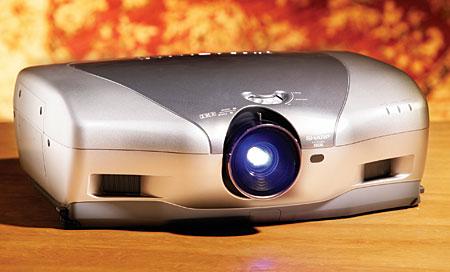
Apart from a slight change in the color of the case, there's little that visibly distinguishes Sharp's new XV-Z12000 DLP home theater projector from its predecessor, the XV-Z10000. The winner of our last Editors' Choice Platinum Award, in January 2004, the Z10000 sailed through the viewing sessions for its coverage in SGHT: a full review in October 2003 and a "Take 2" in November.

 |  Nov 19, 2005

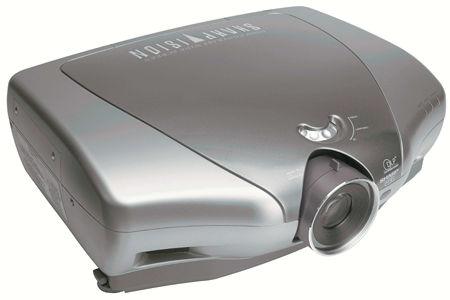
Sharp practically put DLP front projection on the map as a high performance solution when it introduced its XV-Z9000 projector a few years ago. That projector featured the first generation "Mustang Chip," the first 16:9 native 720p DLP chipset from Texas Instruments. Sharp's SharpVision projector line has continued to evolve with TI's chips, with each new generation making incremental improvements over past models. We continue to be compelled to look at each iteration because Sharp's line has remained reasonably priced (between $11-$12k MSRP with "street prices" closer to $10k) and never given up much in pure performance even when compared to premium projectors costing much more.

Geoffrey Morrison  |  Mar 10, 2006
How do you follow up a winner?

Way back in our July 2004 issue, we reviewed this projector's predecessor, which wasn't known as the MARK I. We liked the XV-Z12000's performance so much, we gave it our 2005 RAVE Award for Best Overall Projector. Just a few months shy of two years later, we got a chance to play with the MARK II version.

Thomas J. Norton  |  Jul 06, 2009
Price: $2,500 At A Glance: Outstanding video processing • Deep blacks (with auto iris) • Brightness to spare for a big screen

Sharp has a long history in the home theater projector business. It began with a successful run of LCD models. But the company soon shifted its projectors to Texas Instruments’ DLP technology, which appeared to be ready to dominate the projection business for a time.

However, with the development of new and vastly improved LCD chips and designs in the recent past, all that has changed. LCD (and its second cousin, LCOS—a variation on liquid crystal technology) now dominates the projection market. Sharp is sticking to DLP, and its new XV-Z15000 is one of the first DLP designs to sport a new 0.65-inch digital micromirror device (DMD) from Texas Instruments. The DMD is the imaging chip at the heart of the DLP system.

Thomas J. Norton  |  Sep 21, 2011
2D Performance
3D Performance
Features
Ergonomics
Value
Price: $5,500 At A Glance: Bright, punchy images • Good (though not highly accurate) color • Middling black level and contrast

Many of us here at Home Theater are big on 3D, but a lot of front-projection fans have been holding off. Until recently, their only options in the $5,000 3D projector market were two identical JVC models (sold either through that company’s pro or consumer distribution channels).

Peter Putman  |  Apr 17, 2005

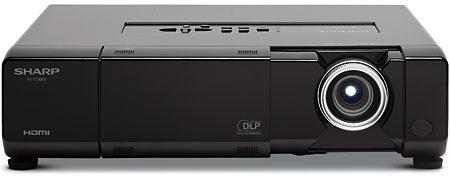
Sharp's XV-Z2000 front DLP projector raised more than a few eyebrows when it first appeared at CEDIA Expo 2004. Was this indeed the first 1280x720 HD2+ DLP projector for less than $5000? If so, it would represent a seismic but long overdue change in DLP projector pricing, which has typically kept the MSRPs of 720p models above $7000—and, by extension, non-competitive with 720p LCD projectors that retail for half of that price or less.

Thomas J. Norton  |  Jan 14, 2007

When 1080p home theater projectors were introduced a year or so ago, a funny thing happened on the way to the party.

Thomas J. Norton  |  Dec 03, 2006

The Sharp XV-Z20000 is the third 1080p single-chip DLP projector to pass through our doors. At $11,999 it bucks a growing trend to less expensive, high resolution projectors. But it's far lower in price than competitors such as the $20,000 <A HREF=" http://ultimateavmag.com/videoprojectors/506marantzvp11s1/"> Marantz VP-11S1</A> or SIM2's $15K <A HREF="http://www.ultimateavmag.com/firstlookvideoprojectors/506sim2ht3000/">
HT3000</A>. And it offers a lot for the money.

Geoffrey Morrison  |  Apr 15, 2007  |  First Published: Mar 26, 2007
What 1080p was made for.

Despite my, and others', repeated assurances that you don't need 1080p on a 42-inch display, that seems to be what people keep concentrating on. Such resolution is wasted on a small screen (unless you're sitting on it). But, in this "mine has more resolution than yours" world, I guess such competitive behavior is inevitable. So, what about the displays that can take advantage of 1080p? Sure, depending on where you're sitting, an RPTV can do so. But, with all the concessions to price, brightness, and market competition, you still won't be getting everything out of the signal. There are a few flat panels that would work. In a size that would let you see 1080p from any distance, though, you'd be looking at the price of a good Mercedes. So, that leaves front projection.

Geoffrey Morrison  |  Sep 08, 2006
A deal in performance clothing

I love surprises. Ok, that's a lie. I hate surprises. How is giving me an attack of tachycardia (learned that one on House) anyone's idea of a good time. But, in the HT world, surprises are usually good. Take this $3,000 projector, for instance. By all accounts, it should be an average performing mid-to-low-priced HD projector. Then you look at the contrast-ratio measurement and see it's better than every other projector we've ever reviewed. Surprise!

Pages

X