Bookshelf Speaker Reviews

Sort By: Post DateTitle Publish Date
Mark Fleischmann  |  Jul 26, 2013

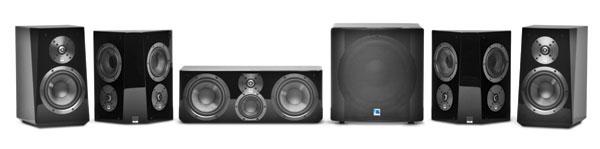
Ultra Speaker System
Performance
Build Quality
Value

SB12-NSD Subwoofer
Performance
Features
Build Quality
Value
Price: $3,348 At A Glance: Distinctive enclosure shapes • Strong build quality • Satisfying, balanced sound

The debut of the SVS Ultra speaker line prompts me to reconsider a question that’s been lurking at the back of my mind for years: Is SVS one of the great American speaker brands?

As a company founded in Ohio and initially operated out of a garage, SVS has all the right narrative elements of a great speaker brand. The company has built a reputation for making brilliantly unorthodox subwoofers and pretty good speakers—versus the scads of respectable brands that put most of their brilliance into speakers and treat subs as an afterthought. In the past few years, the story has added a few new chapters, with new heavy-hitter personnel in management and product design and a manufacturing move from Ohio to (where else?) China.

Mark Fleischmann  |  Jun 21, 2013

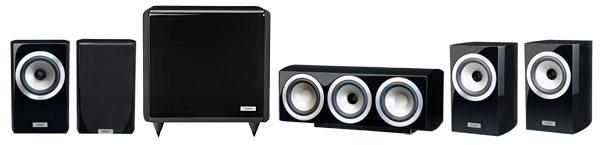
Tannoy Precision Speaker System
Performance
Build Quality
Value

Tannoy TS2.12 Subwoofer
Performance
Features
Build Quality
Value
Price: $4,414 At A Glance: Coaxial driver array • Pinpoint-precise imaging • Clean, wellmannered subwoofer

If you read a lot of British novels, eventually you’ll run across a reference to an announcement “on the Tannoy” in a train station or airport. In the U.K., the birthplace of Tannoy Ltd., the loudspeaker brand is a synonym for public-address system. No other speaker manufacturer in the world enjoys this distinction, though it comes at a price: The Tannoy people are constantly firing off letters to publications that make the mistake of using tannoy generically, without the proper cap-T to indicate its trademark status.

Trivia buffs may be surprised to discover that the firm was founded in 1926 as the Tulsemere Manufacturing Company in England. Not until 1932 did the brand name become Tannoy, an abbreviation for tantalum alloy, a material used in the electronic guts of its early products. Tannoy relocated its design and engineering center to Scotland about a half-century later, and for the past decade has been owned by the Denmark-based TC Group.

Brent Butterworth  |  May 09, 2012

If there’s any speaker spec that’s routinely bogus, it’s bass response. You see a lot of little speakers rated to deliver bass below 40 Hz, but that measurement is almost always taken at -10 dB, instead of the industry standard of -3 dB. Even if the little speaker does hit, say, 36 Hz at some level, it almost certainly can’t deliver any usable volume at that frequency.

There are ways, though, to get legit sub-40 Hz response from a little speaker. One is H-PAS, or Hybrid Pressure Acceleration System, invented by Solus-Clements and now used and licensed by Atlantic Technology.

Brent Butterworth  |  Aug 23, 2012

When I’m looking for speakers to review, I gravitate toward two types: ones that have the potential to sound great, and ones with weird designs. The former offer the potential for hours of joyous listening. The latter offer the potential for either a previously unimagined sonic nirvana or an audio train wreck, both of which are fun to write about.

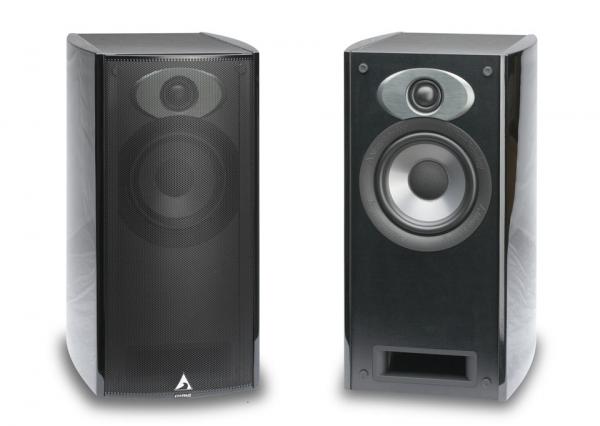
Definitive Technology’s $899-per-pair StudioMonitor SM65 fits both descriptions.

Daniel Kumin  |  Jun 06, 2013

Physicists have long postulated that an ideal sound reproducer would behave as a pulsating sphere. Ever since, the wish being father to the thought, speaker designers have been cramming transducers into balls, as if making the cabinet round would somehow magically make the sound spherical.

Brent Butterworth  |  Nov 30, 2011

Flat-TV friendly speakers from a company best known for its horns. If your speakers are fat, what good does a skinny TV do? Speaker manufacturers have begun addressing that problem in the last year.

Daniel Kumin  |  Feb 13, 2013

Everybody loves small speakers, and why not? Smaller is — often — easier to afford, easier to schlep home, easier to place, and easier to live with. Smaller also has certain acoustical advantages in achieving smooth response and in yielding the broad, even spread of sound that favors good imaging and an open, believable tone color.

But how small is too small? Some say there’s no limit, and at least one manufacturer (Bose) has had success with subwoofer/satellite designs whose sats are smaller than a pepper mill, let alone a breadbox. But as the front satellites of a speaker system become smaller, their ability to reproduce bass low enough to bridge effectively with the practical upper limits of a single subwoofer, at around 150 Hz (and ideally lower), becomes questionable.

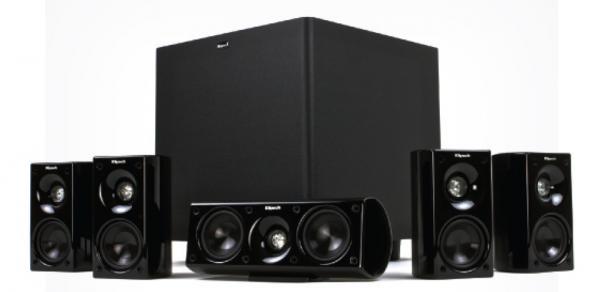
Klipsch thinks it has found the sweet spot with its HD Theater 600 system

Brent Butterworth  |  Apr 12, 2011
Glancing over the stylish, diminutive Paradigm MilleniaOne speaker, you might assume it’s nothing more than a flimsy plastic housing packed with 25-cent drivers scavenged from a parts bin somewhere in the bowels of Guangdong Province. But besides its cute looks, the MilleniaOne has nothing in common with the typical “lifestyle” speaker.
Brent Butterworth  |  Oct 16, 2011

Romantics see Italy as a place of rich history and sophisticated culture. Not me. As a non-romantic, I can think of Italy only as the birthplace of the Fiat 128 that often left me walking instead of driving, and the location of a honeymoon in which I fought frenzied traffic and struggled to find a decent meal.

Brent Butterworth  |  Mar 21, 2012

It seemed that audio companies had surrendered the home-theater-in-a-box concept to the TV manufacturers.

Daniel Kumin  |  Sep 20, 2011

RSL Speaker Systems is the current manifestation of Rogersound Labs, a SoCal company that goes back a few years — 30 or so, in fact. Like many speaker makers, RSL got its start through garage tinkering, in this case by Howard Rodgers, owner of a well-known retail chain of the same name. (How the “d” got dropped from the company name is a story for another day.)

Despite a long, successful run, the original RSL, again like many other speaker companies, eventually faded away. But after regaining rights to the company name just last year, the firm was reincarnated after a long hiatus by its founder and his family.

Chris Lewis  |  Dec 15, 2004
Post-time for B&W, Dynaudio, Phase Tech, and PSB.

The odds of finding a horse for $3,000 that will win the Kentucky Derby are about as good as they are of me hitting the Pick 6 at Santa Anita Race Track—in other words, it ain't gonna happen (although, in the case of the latter, it won't be for lack of trying). Even Seattle Slew, one of the great bargains in horse-racing history, carried an initial price tag of $17,500.

Adrienne Maxwell  |  May 12, 2008
Can the all-in-one soundbar really replace a dedicated home theater system?

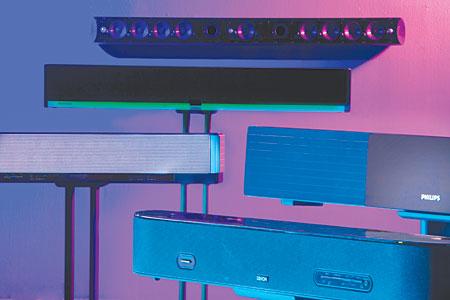
The emergence of the soundbar audio genre can be traced to two trends: 1) consumers’ desire to buy slender, space-saving speaker systems to match their slender, space-saving flat-panel HDTVs; and 2) consumers’ hatred of running speaker wire around the room. Studies show that people either leave their surrounds at the front of the room, which wreaks havoc with the soundstage, or they simply don’t hook them up at all, which is just a shame. To address the former, speaker companies began to incorporate the front three channels of a 5.1-channel system into one slender bar you could place above or below your TV. To address the latter, they took it one step further, putting all five channels into a single bar and using acoustic manipulation to create a sense of surround envelopment. It seems like every major speaker manufacturer is now jumping on the soundbar bandwagon, but does the technology really work? Can one speaker honestly re-create a 5.1-channel soundfield, and what kind of sacrifices must be made to do so? To find out, we brought in the latest soundbar models from Philips, Marantz, Yamaha, Denon, and Polk.

Steve Guttenberg  |  May 12, 2008
Sonic sorcery.

Jim Thiel must be a magician. At least that’s what I thought when I first heard his newest speaker, the SCS4. I was listening to an a cappella band, and the guys were all there—not just the voices, but I felt like the Persuasions were in the room with me. The sound was so utterly natural; it was as if the speakers weren’t doing anything.

Pages

X