When the 3D Blu-ray spec was announced, everyone said it would require HDMI 1.4, which implied the need for new HDMI hardware. But then I learned that the Sony PlayStation 3, which has HDMI 1.3, can be updated to provide 3D capabilities with new firmware. That seemed odd, so I visited the HDMI Licensing booth and found out that all the versions of HDMI are merely specifications that define what features they will support, and manufacturers are free to implement all, some, or none of them. Also, HDMI 1.3 and 1.4 are capable of the same maximum bandwidth—10.2Gbps.
Panasonic not only made the biggest push for 3D at the show, it also had the most consistently effective demos. All used shutter glasses, and all of Panasonic's new plasma sets are claimed to use faster phosphor elements to minimize left-right crosstalk (lingering images can be an issue when separate images must be presented for each eye. (Hopefully the new phosphors won't compromise color accuracy. The color in the demos looked fine, but such demos invariably deviate from the D6500 color standard.)
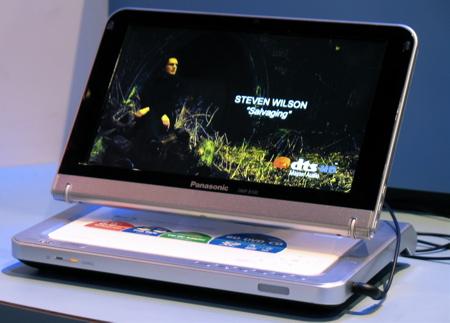
Panasonic showed two new portable Blu-ray players, the 10.1-inch DMP-B500 and the DMP-B100 (shown here). They don't have full HD resolution, but that shouldn't be a negative with such small screen sizes. I want one; they looked better, with a BD disc, than any portable DVD player I've ever seen. The one missing feature is an external video input. Why is that important? The player could then perform double duty as an off-screen monitor for use with a big screen projection system when it isn't needed as a portable device. An OLED display instead of the LCD imaging used here would also be nice, but a $3000 portable OLED Blu-ray player might be a hard sell
A demo of Toshiba's new top-of-the-line Cell LCD HDTV, with its 500+ zones of full backlit LED local dimming side-by-side with last year's LED local dimming set with far fewer LED zones, was exceptionally effective, even if too much was made of the new set's increased brightness (and too much of it used for the darkened demo room) . Toshiba claims a peak of 1000 cd/sq meter -- that's close to 300 foot-lamberts, nearly 10 times what I'd recommend for a good picture in a darkened room. Hopefully
a movie or cinema mode will produce a more sensible brightness level.
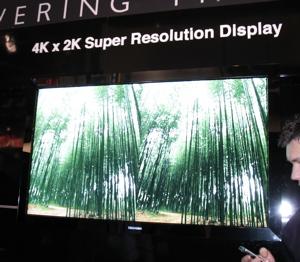
Toshiba showed a split-screen demo of 4K resolution on a relatively small LCD set. The purpose was apparently to show how their new Cell processing can upconvert 2K sources to 4K. You can't see anything in the photo, but on-scene the 4K was a bit sharper-though the 2K side looked softer than I would expect from good 2K material.
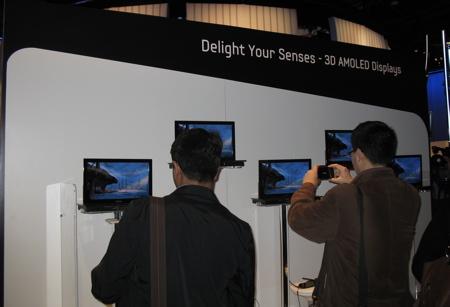
While no one was announcing any serious plans for OLED sets, Samsung did show 3D on these small OLED displays. Sony also showed OLED 3D on somewhat larger (under 30-inch) models.
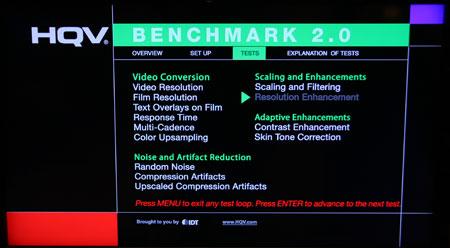
Many video reviewers use the original <I>HQV Benchmark</I> DVD and Blu-ray test discs in their evaluations of displays, players, and processors, but those discs are getting a bit long in the tooth, and there are a couple of errors on them that limit their usefulness in certain tests. Now, IDT has released version 2.0 of both discs, and they look fantastic. (During the development process, IDT solicited feedback from several reviewers, including Tom Norton and me, and I'm gratified that they actually took our advice.)
As you may already know, the intellectual property rights for HQV video processing were purchased by IDT some time ago, and the company has been working on new chips since then. I've seen demos of prototypes a couple of times, but I was under NDA (non-disclosure agreement) until now. I can finally talk about the HQV Vida chip, which will soon be available in AVRs, Blu-ray players, and video processors.
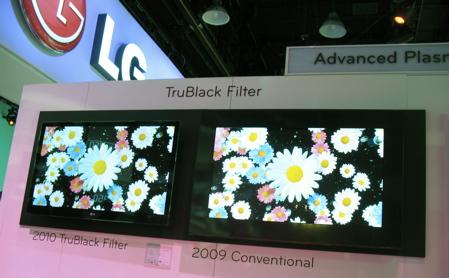
Like other manufacturers at the show, LG was showing off the claimed better blacks of its new sets. TruBlack is the company's designation for the upgraded black levels in its new plasma sets, like the 2010 PK950 shown here. While it wasn't easy to see the improvement on the brightly lit show floor, the new set did look subtly better.
No, I'm not going into Canon's consumer HD cameras here, But rather give a shout-out to the Canon tech folks whe helped me with a minor problem that locked out the Canon camera I was using at the show. I was in a near panic, pondering the potential waste of two hours of show time to go back to the hotel for my spare camera, when it occurred to me that Canon might just have a booth at a consumer electronics show. Duh! They did, and they got me going again.