- REVIEWS
Displays Electronics 
Speakers Sources Other Gear Software - HOW TO
How To Buy How To Use Tech 101

LATEST ADDITIONS
 Juergen Herre, chief scientist at Fraunhofer Institute for Integrated Circuits and professor at Erlangen University in Germany, discusses the development of the MP3 audio format (technically called MPEG-1 Layer 3), how lossy audio codecs work using psychoacoustics, how higher bitrates yield higher audio quality, constant versus variable bitrates, more recent audio codecs such as MPEG-2 AAC and surround MP3, 3D audio, object-oriented audio, answers to chat-room questions, and more.
|
May 15, 2012



|
May 11, 2012
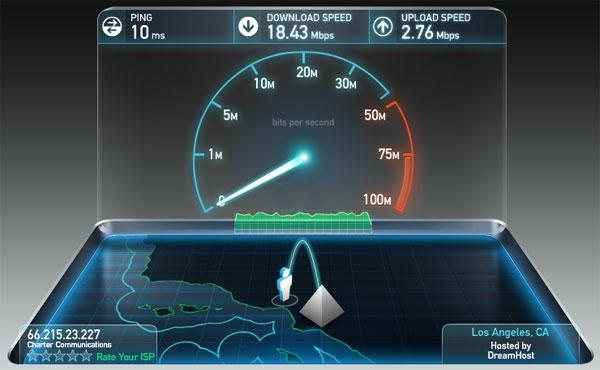
In this week's Home Theater Geeks podcast, Boxee co-founder and CEO Avner Ronen talks about the new paradigm of streaming TV. Of course, the image and sound quality depend greatly on how much downstream bandwidth you havefor 720p, many people recommend at least 3 to 4 megabits per second (Mbps), while 1080p normally requires 6 Mbps or more. (Vudu specifies 2.25 Mbps for 720p and 4.5 Mbps for its HDX 1080p stream.)
Which leads me to ask, what is the downstream bandwidth in your home? If you don't know, there are several websites that let you measure it, both downstream and upstream; I use speedtest.net, which yielded the results shown above at my home, where Charter Cable provides my Internet access. If you know how much bandwidth you're paying for, you might want to verify it. Also, I'd love to know if your broadband Internet access is provided by DSL, cable, or another servicemy impression is that cable is generally faster than DSLso please leave a comment about that if you would be so kind.
Vote to see the results and leave a comment about your choice.


Pages







| Displays Electronics Speakers | |
Sources Other Gear Software | |
Top Picks of the Year Top Picks | |
Custom Install How To Buy How To Use | |
Tech 101
|
|
Latest News Features Blogs | |
Resources Subscriptions |
WHERE TECHNOLOGY BECOMES ENTERTAINMENT
 © 2026 Sound&Vision
AVTech Media Americas Inc., USA
All rights reserved